The Signals Hub Imperative: Why Every B2B Company Needs One

Let's Talk About the Elephant in Your Pipeline
Here's a scene that plays out at thousands of B2B companies every single week: The marketing team reports a record month of website traffic. The sales team shrugs because they have no idea who any of those visitors are. Meanwhile, three prospects who visited the pricing page four times last Tuesday just signed with a competitor - and nobody on your team even knew they existed.
Sound familiar? You're not alone.
The uncomfortable truth is that most B2B companies are sitting on a mountain of buying signals they can't see, can't organize, and can't act on. The signals are there - people visiting your site, researching your category across the web, engaging on LinkedIn, changing roles at target accounts - but they're scattered across a dozen disconnected tools, and by the time anyone notices, the moment has passed.
97% of your website visitors leave without ever telling you who they are. That's not a leaky funnel - that's a funnel with no bottom.
The Real Problem: Death by a Thousand Data Silos
Let's be honest about what's broken. It's not that your team doesn't work hard. It's not that you lack tools - if anything, you have too many. The problem is fragmentation. Your website analytics live in one place. Your ABM tool lives in another. Intent data from a third-party provider sits in a spreadsheet someone downloaded last quarter. Your CRM has contacts, but no behavioral context. And your SDRs? They're doing their best to piece it all together manually, one Chrome tab at a time.
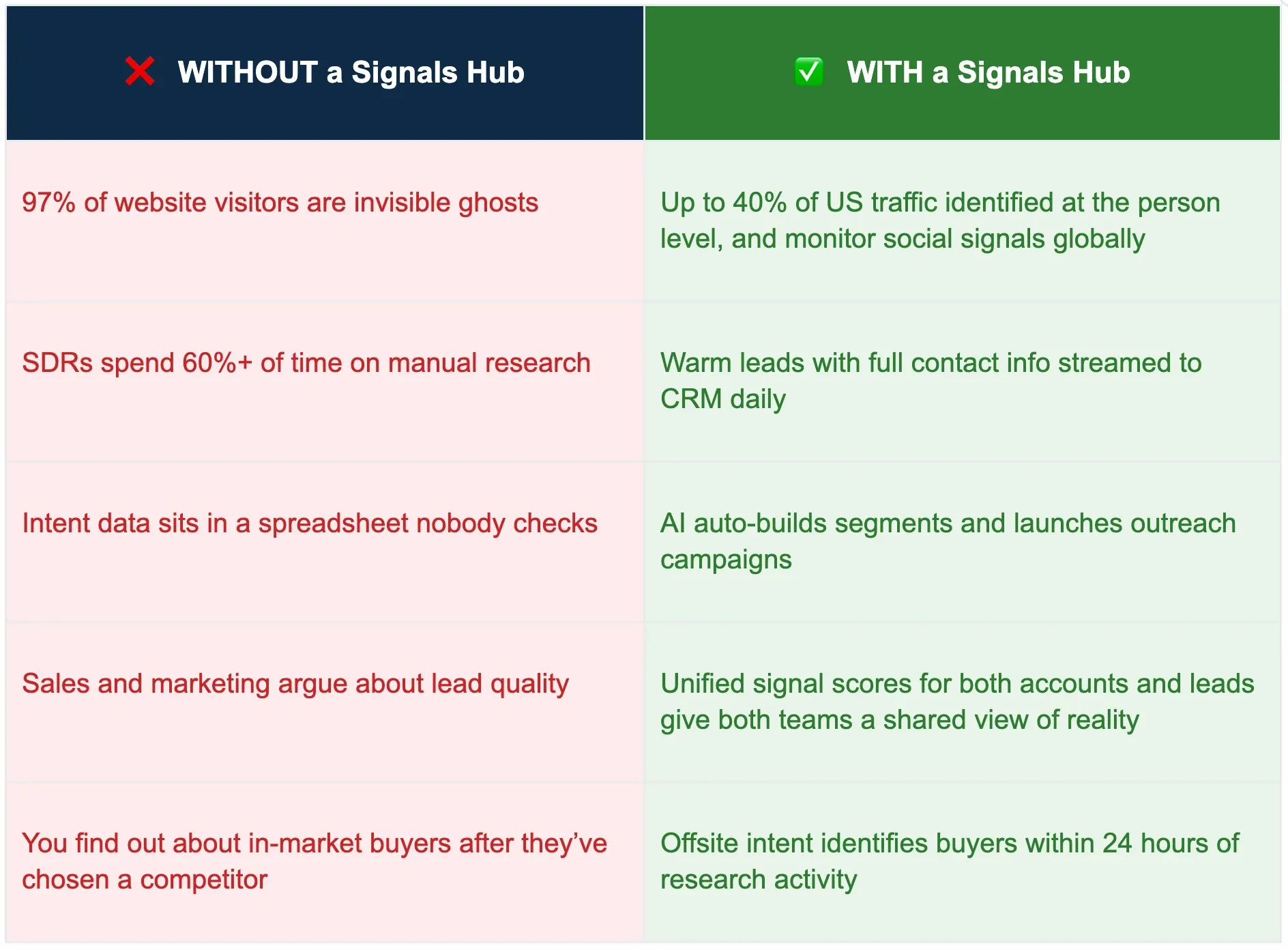
So What Exactly Is a Signals Hub?
Think of it this way: if your CRM is the filing cabinet and your marketing automation is the mail room, then a Signals Hub is the radar system that tells you where the planes are flying before they land on your runway.
A Signals Hub is a unified platform that captures, enriches, and activates buying signals from every corner of your digital ecosystem - your website, the broader web, social channels, your CRM, and third-party intent sources - and turns them into a single, actionable stream of buyer intelligence for your entire GTM team.
Kwanzoo's Signals Hub, for example, brings together five key signal types:
• Person-Level Website Visitor ID - Person-level identification of anonymous visitors with name, title, email, LinkedIn, and phone. Not just “Someone from Microsoft visited.” The actual person. Up to 40% identification rate on US B2B traffic.
• Offsite Intent Leads - Real-time identification of buyers researching your category across 90,000+ media websites - with full contact details, delivered within 24 hours.
• Account Intelligence - Unified account level intent scores from multiple sources, so you know not just which accounts are in-market, engaging on your website, and how ready they are and where to focus.
• Contact Monitoring - Track role changes, funding events, and new research activity from existing CRM contacts - signals that indicate renewed buying potential.
• AI Playmaker - Automatically builds dynamic segments and launches personalized campaigns across email, LinkedIn, and phone based on live signals.
The key difference from ABM solutions like 6sense, or Clearbit? Those tools each handle a slice of the picture at the company level. A Signals Hub unifies everything into one operational view and makes it actionable - automatically.
THE SIGNALS HUB PIPELINE FUNNEL
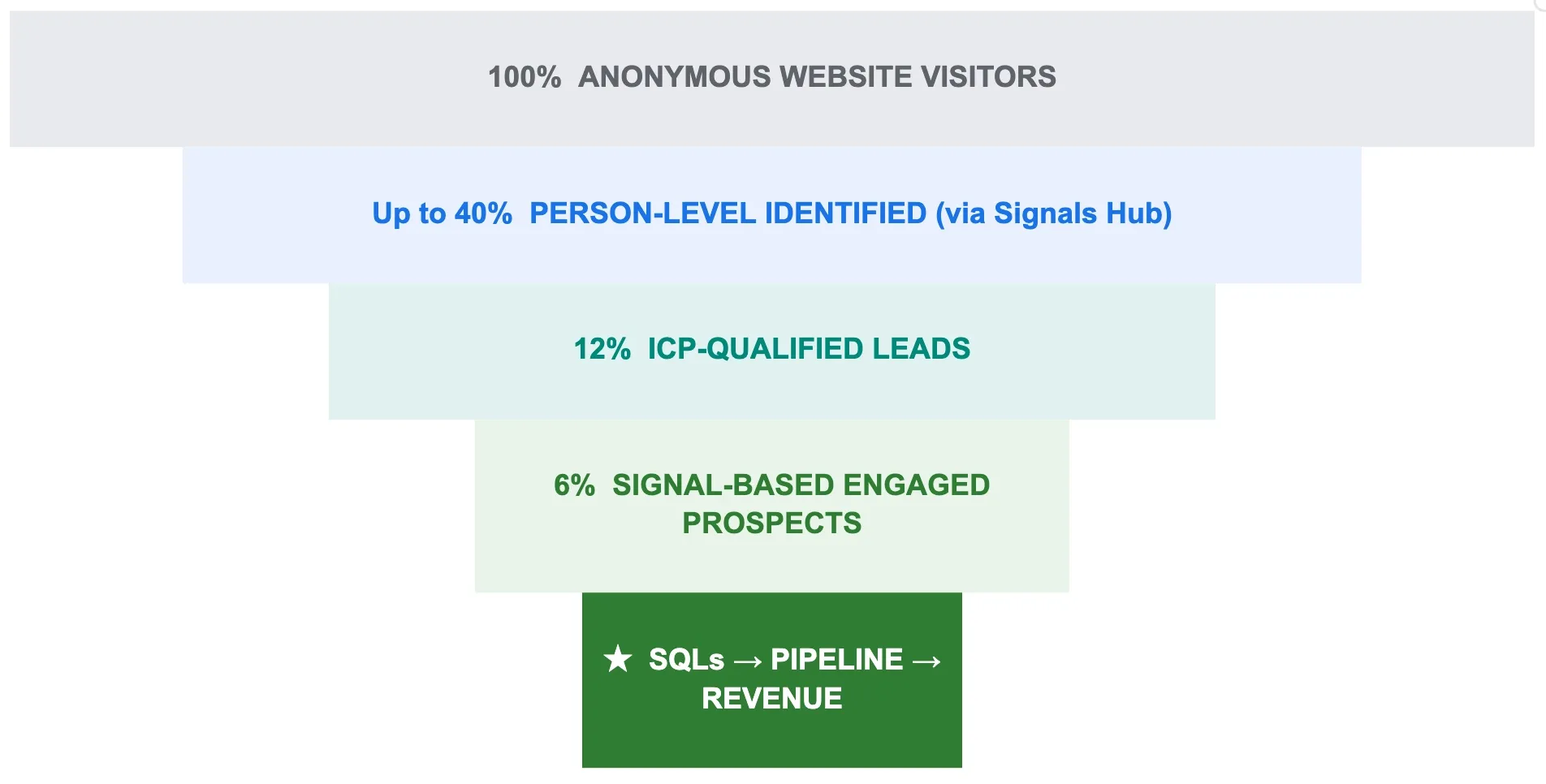
Each stage powered by unified buying signals - zero manual research required
Proof, Not Promises: Two Companies. Real Results.
Theory is nice. Numbers are better. Here's what happens when B2B companies stop guessing and start using a Signals Hub - drawn from Kwanzoo's published case studies and customer results.
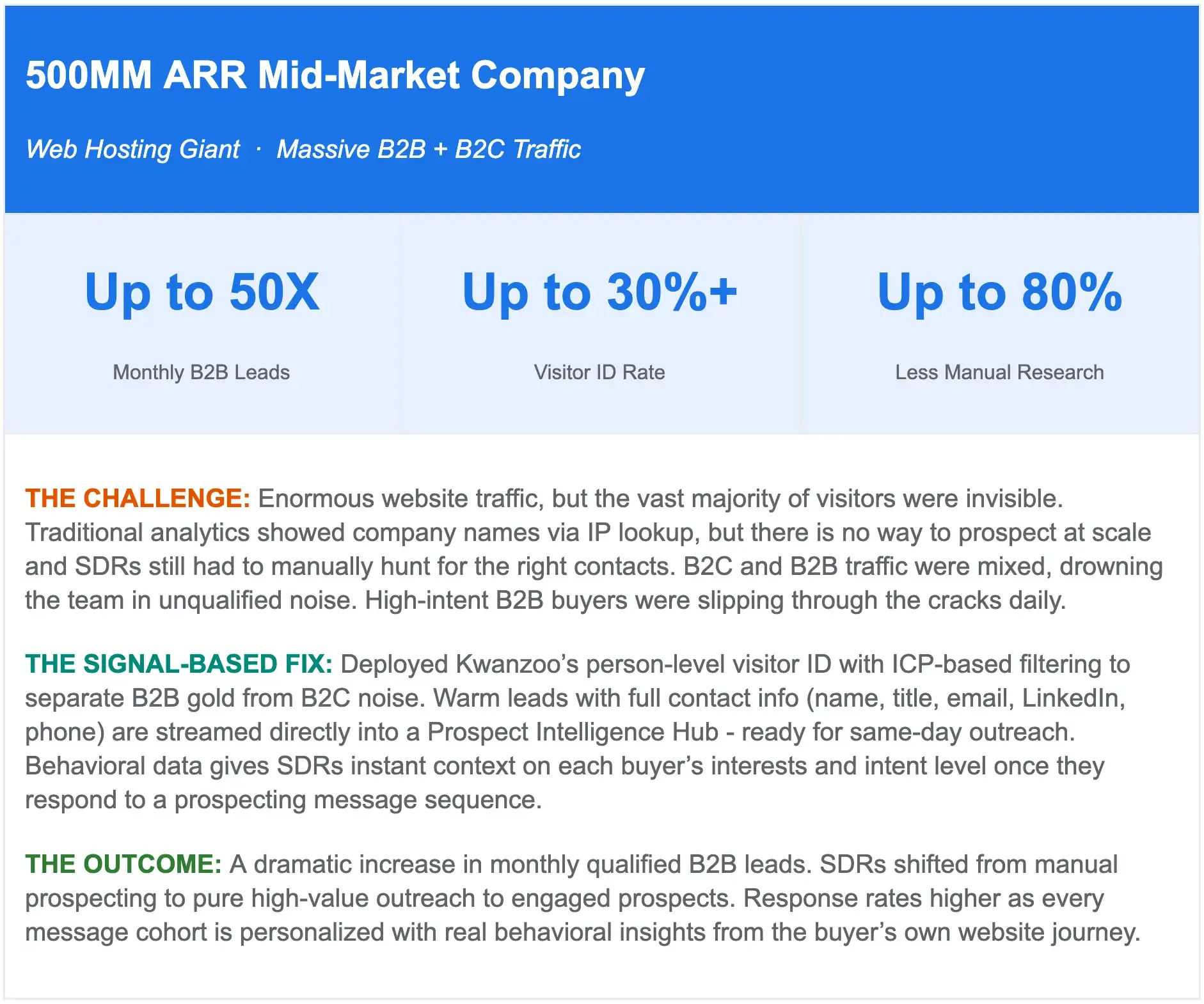
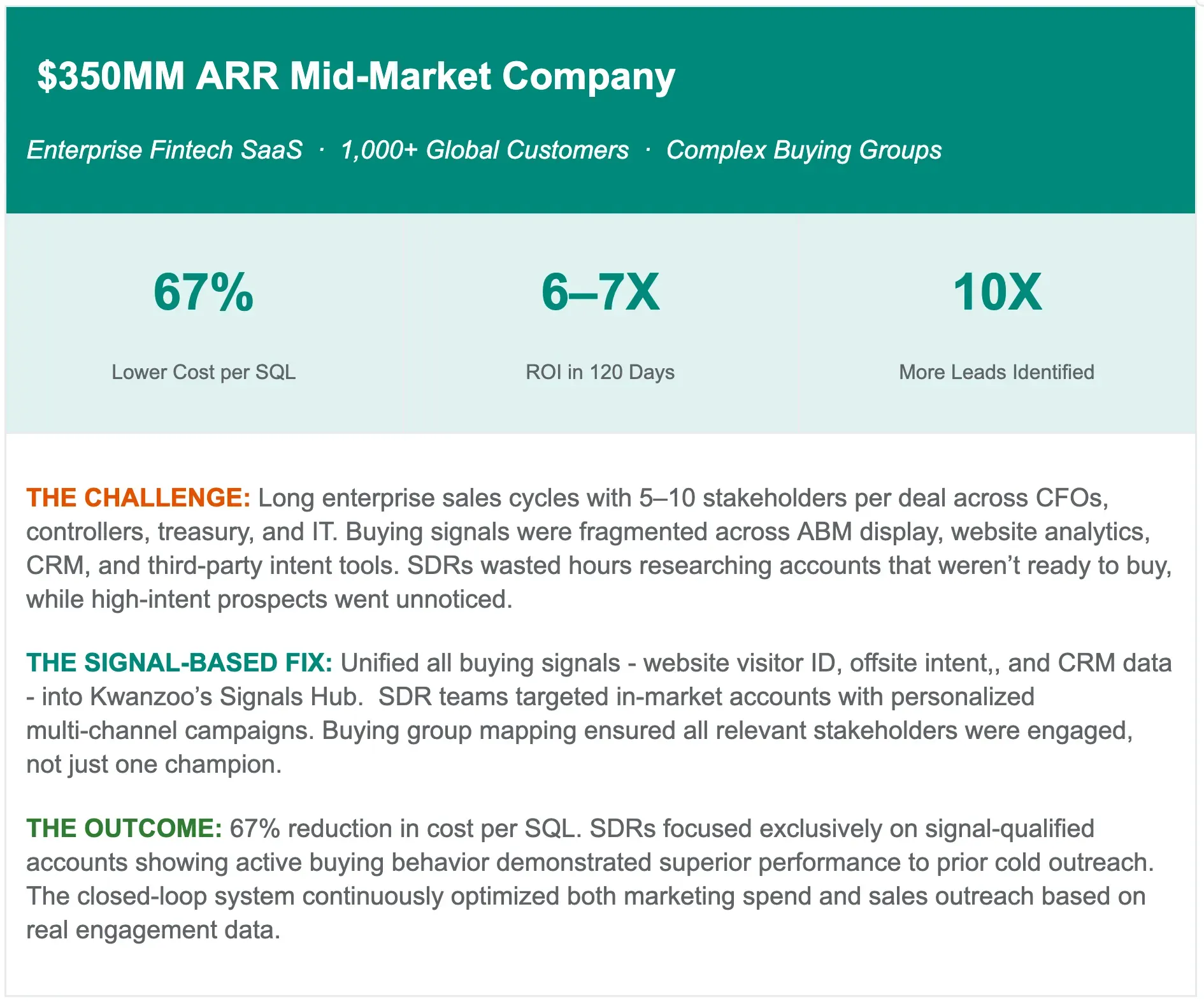
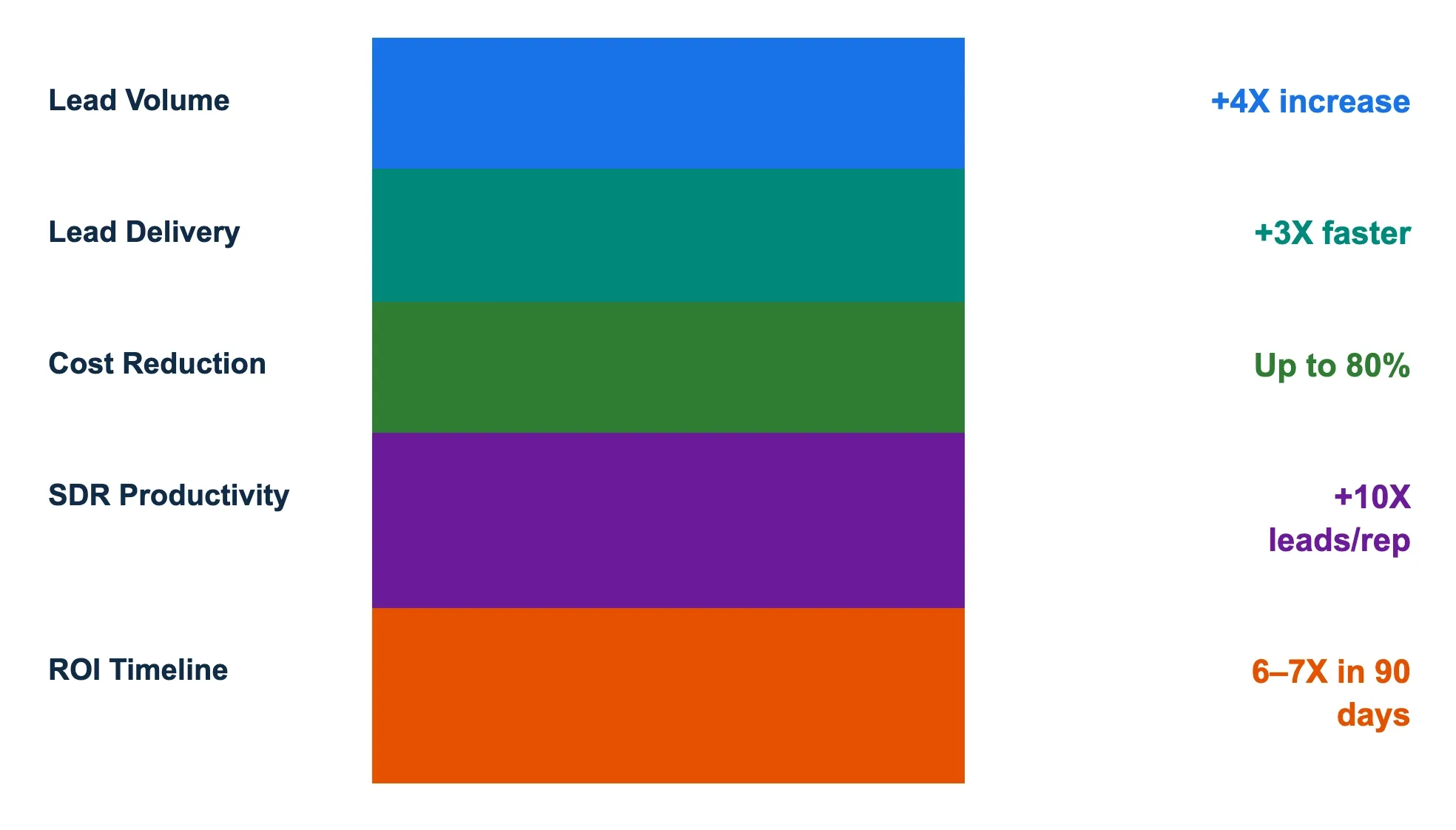
The Signal-Based Advantage: By the Numbers
IMPACT OF ADOPTING A SIGNALS HUB (Kwanzoo customer benchmarks)
Your Signals Hub Playbook: Five Moves to Make This Quarter
You don't need a six-month implementation cycle. Here's how to get started - and start seeing results - fast:
1. Deploy Person-Level Visitor ID on Your Website: This is the single highest-impact move. Add Kwanzoo's lightweight script and start identifying real buyers from your existing traffic within days. No forms required. You'll go from 1-2% visibility to up to 40% overnight.
2. Turn On Offsite Intent Monitoring: Start receiving daily feeds of in-market buyers who are actively researching your category across 90,000+ media sites - with full contact information. These are people who haven't visited your site yet but should be on your target list.
3. Activate AI Playmaker Campaigns: Let AI build dynamic signal-based segments and auto-launch personalized outreach across email, LinkedIn, and phone. Your SDRs go from doing research to having conversations.
4. Measure, Optimize, Repeat: Track which signals drive the most pipeline and revenue. Double down on what works. Kwanzoo customers report clear ROI within 90 days - this isn't a long bet.
The question isn't whether signal-based Go-to-Market will become the standard - it already has. The question is whether you'll be the company wielding it, or the company wondering where all the deals went.

Mani Iyer
Serial entrepreneur and B2B GTM expert with 34+ years of experience building and scaling technology businesses. Founded Kwanzoo as an AI-powered Go-to-Market automation platform after previously founding a software company acquired by Oracle/PeopleSoft.

